
Compare Three Colquitt County Property Value Numbers
The Colquitt County tax information page draws the line between the assessor's valuation work and the Tax Commissioner's billing role. Three different numbers answer three different questions. Each must stay paired with its date and label.
| Value | What It Is | Where |
|---|---|---|
| Fair market value | The assessor's January 1 opinion of full value for the digest | Board of Tax Assessors and qPublic |
| Assessed value | Forty percent of fair market value under Georgia's assessment rule | Assessment record and notice |
| Sale consideration | The amount reported with a transfer, subject to the instrument's context | Deed or PT-61 record through Clerk/GSCCCA |
| Land and improvements | Components that may support the total valuation | Parcel card if displayed |
Georgia sets its assessment level at 40 percent. A $100,000 fair market value would yield a $40,000 assessed value. That figure comes before exemptions or other adjustments. The example shows the ratio only. It values no actual Colquitt County parcel.
Each label also marks a different stage of the record. Fair market value is the county's full-value opinion as of the statutory date. Assessed value applies the statewide fraction. Taxable value may reflect exemptions or special programs after that math runs. Sale consideration, by contrast, belongs to a conveyance on its own date. Compare the figures only when the parcel number and year match. Never treat one label as a substitute for another in Colquitt County property records.
January 1 Fixes Colquitt County's Annual Value Date
January 1 is the value date that governs Colquitt County assessments. Fair market value is fixed as of that day. The assessor's digest therefore works like a dated annual snapshot. Anything that changes afterward can lag. A renovation, a demolition, a sale, or a shift in local demand may not appear in the displayed property value for that same tax year.
The qPublic landing page describes its figures as the most current published digest. That wording matters when two people quote different amounts for the same parcel. Each may hold a valid number pulled from a different cycle. So note the tax year behind any value before relying on it.
The official Colquitt assessor entry page explains that its information reflects the most current published digest.
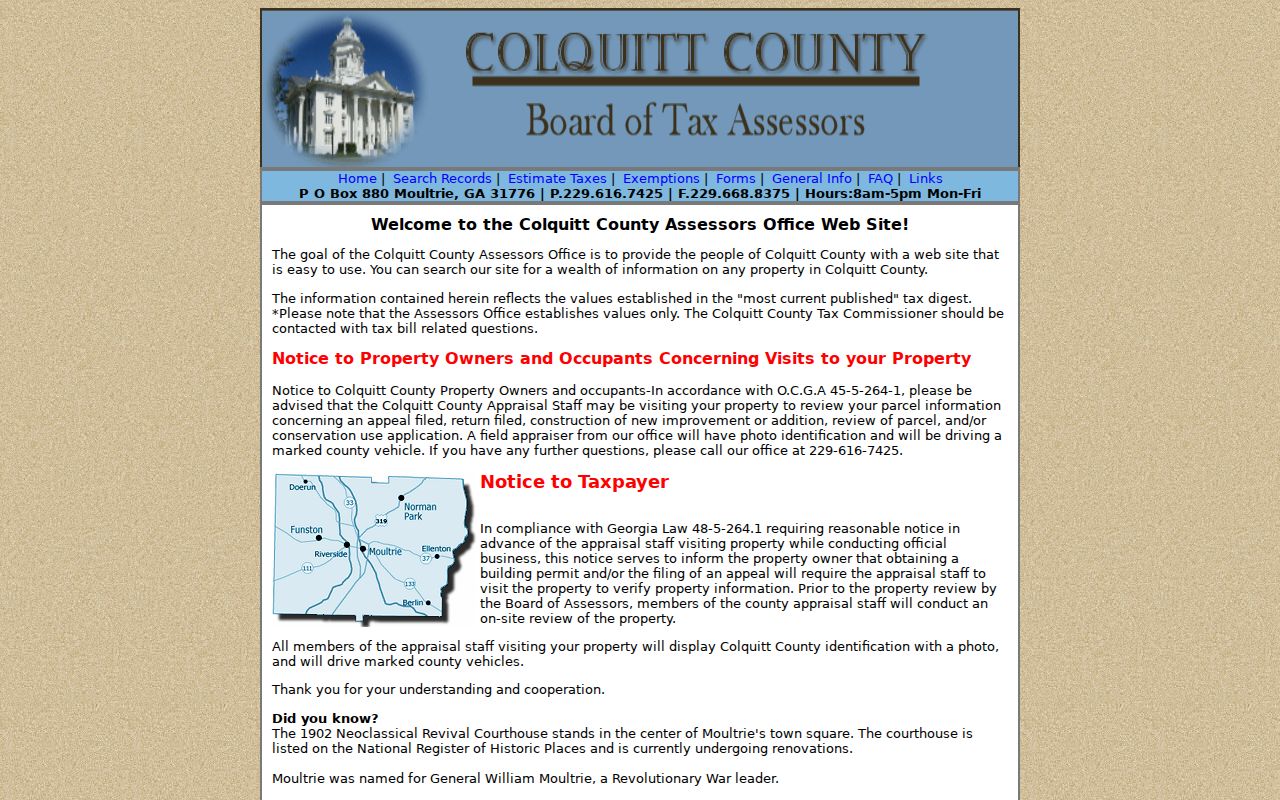
The county landing page provides the official value-search route into the parcel records. The parcel card itself supplies the tax year and value labels worth recording.
Colquitt County Uses Georgia's 40 Percent Assessment Level
The Georgia Department of Revenue valuation guide states that county property is assessed at 40 percent of fair market value. Fair market value is the assessor's full-value opinion. Assessed value is the statutory fraction that feeds the tax process.
- Fair market value
- The county appraisal opinion as of the annual valuation date.
- Assessed value
- Forty percent of fair market value for Georgia property taxation.
- Assessment ratio
- The mathematical relationship between assessed and fair market value.
- Reassessment
- A later review that may change the digest value.
Exemptions can change the taxable amount without changing what a buyer paid. The value labels live here. The bill, exemption rules, and appeal steps belong in the Colquitt County property tax guide.
Land, Buildings, and Total Value Need Exact Labels
A Colquitt County parcel card may list land and improvement values separately. The card then totals them into one fair market or assessed figure. Field names and value-history behavior vary by county. Copy the labels exactly as the result displays them. Do not borrow terms from another county's parcel records.
A detached structure, an agricultural classification, or an exemption can muddy a simple total. Multiple parcel IDs can muddy it too. Confirm every figure belongs to the same APN, tax year, and legal parcel.
The assessor handles appraisal. The Tax Commissioner handles billing and collection. That split matters once a value question becomes a balance question. How was an assessment stated? The parcel card or annual notice is the better source. The Tax Commissioner's system tracks the resulting bill, payment, delinquency, or levy status. An amount due never explains the appraisal method on its own.
Note: If qPublic does not open, ask the assessor for the public parcel record. Ask also for the effective date of the displayed digest.
Look Up a Colquitt County Assessed Value
The official Colquitt County qPublic page is the assessor's route into the parcel data. Its interface supports address, owner, parcel ID, alternate ID, and broad search modes. Live Colquitt search fields are not publicly testable, so expect some variation in what opens.
- Search the full situs address; if it misses, use the exact parcel ID or owner spelling.
- Open the correct parcel and record the APN, value labels, tax year, exemptions, and land or building components shown.
- Search the Clerk or GSCCCA transfer record if a sale amount is relevant.
- Compare dates and definitions before comparing any two numbers.
- Sale consideration
- An amount associated with a transfer, not a standing appraisal.
- Tax year
- The annual cycle to which an assessment belongs.
- Parcel ID
- The key used to keep value and land identity together.
Recorded Sale Consideration Is a Separate Colquitt County Fact
The GSCCCA search systems offer deed and PT-61 routes for transfer research. A sale figure shown by qPublic should not be assumed to equal the consideration. That figure comes from the recorded instrument. The two facts come from different records.
Not every transfer is an ordinary open-market sale. Estate conveyances, related-party deeds, partial interests, corrective instruments, or bundled property can appear here. These can make consideration a poor stand-alone estimate. Always read the instrument type and legal description alongside the deed records.
GSCCCA organizes searches by party, county, book-page, dates, geographic scope, and property fields. Those property fields appear where participating data supports them. Image access can depend on the service level. Recorded consideration is not always exposed online. In that case, take the instrument reference to the Colquitt County Clerk of Superior Court. Do not guess from transfer tax, an unverified parcel-card field, or a commercial estimate.
Planning Signals Do Not Set Colquitt County Property Value
Moultrie's corridor plans and Norman Park's Town Center and Rural Residential areas give useful land-use context. Doerun's city-limit talks do too. They do not set a parcel's market value. A proposal can change. A postal city can even differ from municipal jurisdiction. Confirm the parcel first. Then use current zoning, permit, annexation, road, and utility records to explain its setting. Never turn a plan line or a nearby project into an unsupported value adjustment.
Nearby sales deserve the same caution. A neighboring parcel can differ in acreage, legal access, structures, condition, zoning, or exemptions. The nature of its transfer can differ as well. When a portal displays comparables, note the selection date and the traits used. The county offers no comparable-sales tool. No such local feature should be promised for Colquitt County property research.
One Colquitt County Value Cannot Answer Every Question
The tax-roll owner, the GIS line, a directory entry, and the assessed value each answer one narrow question. None of them proves present title. None fixes an exact boundary, occupancy, or a likely sale price. Keep every item in a value file attached to its official source and effective date.
Buying or selling? Inspect the property, review comparable transactions with qualified help, and get an appraisal when appropriate. For the tax record, ask the assessor to explain its method and data. A factual feature may be wrong. If so, document the discrepancy with the parcel ID, a photograph or permit, the recorded deed, or a survey. Then contact the assessor. A value disagreement follows the county's assessment-notice and appeal process. It is not a correction to deed consideration. Check current deadlines and forms with the office. An old page or a prior-year notice may no longer govern.
Know What Colquitt County Property Value Cannot Prove
A Colquitt County property value is an official assessment figure. It has a specific public purpose and date. It is not a promise. It cannot guarantee an asking price, a contract price, a lending decision, a repair cost, or proceeds from a future sale. The assessment may also rest on property records that need correction. Verify before relying on it.
Value is not price. A Colquitt County assessed value supports taxation and is not what the property will sell for. A current market conclusion requires an appropriate appraisal.