
Read the Colquitt County Current Owner Snapshot
The Colquitt County qPublic landing page states that its data reflects the most current published tax digest. Start there. Colquitt County parcel cards vary in wording, so read the exact labels from your own result rather than another county's format. Capture the owner, parcel number, and tax year.
| Owner or ownership display | Copy the name exactly as qPublic presents it; do not infer an occupant. |
|---|---|
| Mailing address | The destination used for tax correspondence, which may be an agent or a different address. |
| Situs address | The physical address used to locate the parcel. |
| Parcel or alternate ID | The stable search key for matching the roll, map, deed, and tax account. |
| Value and tax year | The annual assessment context for the owner display. |
| Sale or deed reference | Use only if visible, then verify against the Clerk's recorded instrument. |
An owner display is not an occupancy record. A mailing address routes property-related mail. It cannot prove where anyone lives. Before moving on, save the parcel ID, the tax year, the URL, and the date checked so the snapshot still makes sense months later. The generic Schneider result model lists columns for parcel, alternate ID, address, ownership, city, area, state, assessed value, reference number, and township-range-section. Treat that only as a rough guide. Colquitt County labels may not match it word for word. Quote the actual result on screen. Never fill a missing field from memory. The official assessor landing page is the county's route into that record system.
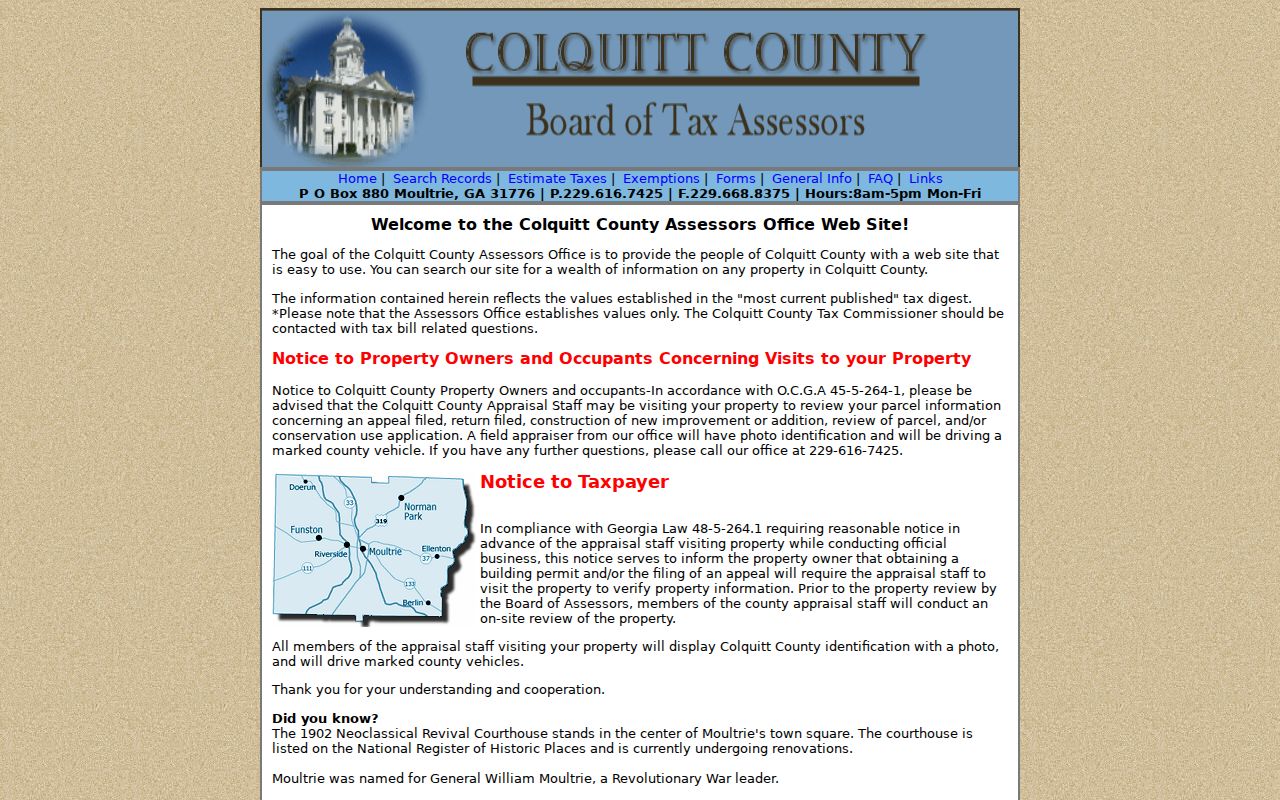
It confirms the right county source. Even so, it does not replace close inspection of the parcel result itself.
Colquitt County's Roll Is an Annual Owner Snapshot
Georgia property is valued as of January 1, and Colquitt County describes qPublic as the current published digest. That makes the roll a dated assessment record, not a live feed of every closing. No official county source located during research states a standard closing-to-roll delay or a fixed refresh schedule.
For a recent sale, ask the Board of Tax Assessors what date the displayed roll reflects. Compare that answer with the deed recording date. The absence of a published lag is a reason to verify, not a reason to invent a waiting period.
Note: Record the tax year and access date whenever a Colquitt County current owner result may be used later.
Owner, Mailing Address, and Situs Mean Different Things
Three fields answer three different questions. The tax-roll name shows the taxpayer or owner of record tied to the parcel, the mailing address routes tax notices, and the situs marks the land's physical location. They can differ without any error.
- Owner of record
- The party shown by the relevant public record at its stated date.
- Assessment roll
- The annual county record used to list property and value for taxation.
- Situs
- The parcel's location address, which is distinct from an owner's mailing address.
- Recording lag
- The interval between a conveyance and its appearance in another public system.
A tax notice may go to an out-of-county address, a company, or an agent, so use it only for legitimate property correspondence. It is never proof of personal residence.
Check Colquitt County's Owner Against the Newest Deed
Two offices split the work. The Clerk of Superior Court records deeds, while the assessor maintains the tax roll. For statewide deed records, the GSCCCA search systems provide the real-estate index, with name, book/page, date, and geographic search modes documented by the authority. Image access may require an account. Some modes may as well. When qPublic and a recent closing differ, the newest recorded conveyance is the better confirmation. Match the county first. Then check parcel, legal description, grantor, grantee, and recording date. A same-name hit is not enough. The land description must match too. GSCCCA documents statewide deed-index transactions from at least January 1, 1999, and older historical data continues to be added. That is not a Colquitt image cutoff. If an index result lacks an image, save its book-page or instrument reference and request the record from the Clerk at 9 South Main Street in Moultrie, where weekday hours run 8 a.m. to 5 p.m.
Confirm the Current Colquitt County Property Owner
A two-source check keeps the question honest. Use qPublic for the parcel and tax-roll lead, then let the recorded deed confirm the Colquitt County owner of record.
- Search qPublic by the complete situs address, exact owner name, parcel ID, or alternate ID, as the portal permits.
- Save the parcel number, exact displayed owner, mailing address, situs, tax year, and any deed reference.
- Search the GSCCCA Real Estate Index for the newest deed tied to that grantee and legal description.
- If the owner is a company, preserve its exact spelling and cross-check the Georgia business record.
- Grantee
- The party receiving an interest in the recorded conveyance.
- Vesting
- The deed language stating who takes the interest and how it is held.
- Registered agent
- The official contact shown for a Georgia business entity, not proof that the entity owns land.
Resolve LLC, Trust, and Estate Owner Names in Georgia
A Colquitt County owner of record may appear as an LLC, a trust, a trustee, or an estate. Copy the style exactly. For companies, the Georgia Secretary of State business search accepts a name, control number, registered-agent name, or officer name. Its entity record supplies status and contact context. It still does not prove parcel ownership. Trusts may be listed by trust or trustee. An estate search may need the phrase "Estate of," an executor or administrator, and the later conveyance. In every case, return to the legal description and the recorded deed instead of treating an entity search as title evidence.
A Free Colquitt County Filing Alert Watches Future Activity
After confirming the current owner, monitoring comes next. The official GSCCCA Filing Activity Notification System tracks new filing activity by the name, address, or document criteria you choose. It launched in 2023, and GSCCCA reported nearly 85,000 users through June 30, 2025. The reach of FANS is forward-looking only. It cannot repair an old chain of title. It also cannot prevent fraud, and it does not guarantee a notice for every relevant filing. Confirm alerts with the Clerk and original instrument.
Note: Enter name variants deliberately, since trusts, estates, and companies may be indexed differently than individuals.
Use the Colquitt County Counter When Online Access Fails
Online access here has real limits. The Colquitt County parcel search sits behind a Cloudflare gate, and GSCCCA images can depend on your account level. A blocked screen is not the end. Ask the Board of Tax Assessors for the roll date and the public parcel record. The Colquitt County Clerk of Superior Court at the courthouse holds the newest deed or recording reference.
The Georgia Open Records Act, O.C.G.A. §§ 50-18-70 et seq., adds another path. It supports a focused request to the actual custodian. Georgia Attorney General guidance allows oral or written requests. Agencies generally respond within three business days. That reply brings the records, a timetable, or the legal ground for withholding any of them.
Spell out what you need. Name the parcel, tax year, and date range. Add the exact deed references or fields, ask for an estimate before a large search, and request the public redacted copy when a record contains protected data. The Act opens existing records without forcing new reports or exempt disclosures, and a narrow request is most likely to reach the right file while preserving the context that verifies the current owner of record.
Use Colquitt County Owner Records Lawfully
A tax mailing address serves one purpose. It is the official route for notices, not a basis for guessing where someone lives or assembling a sensitive profile. Georgia records can redact protected identifiers and certain protected addresses, and VoteSafe keeps residence information confidential in the voter context for qualified participants. Do not try to defeat those protections.
Current record, not title opinion. A tax-roll owner can lag a recent sale. Confirm the newest recorded deed, and never use public owner data to stalk, harass, threaten, or harm anyone.